Sleep Apnea Testing
Sleep Apnea Testing in Santa Barbara, CA for Restful Sleep
Struggling with chronic snoring or waking up feeling exhausted? These could be signs of sleep apnea, a condition that disrupts your sleep and affects your health and quality of life. Jeffrey A. Stratford-Jones, DDS, offers sleep apnea testing to diagnose the severity of your condition with options to help you sleep better at night. With today’s modern technology, a sleep study doesn’t require you to spend the night in a clinical lab. You can complete testing in the comfort of your own home, ensuring accurate results based on your natural sleep environment.
Understanding the Types of Sleep Apnea Tests Available
Traditional sleep studies require an overnight stay in a specialized lab. Modern technology has made diagnosing the condition much more convenient, enabling our dental practice to offer this service. By taking a sleep apnea test at home, you can spend the night in the comfort of your own bed and monitor your breathing and oxygen levels in conditions true to a typical night. A polysomnography, an in-lab study, is more comprehensive but can be uncomfortable and disruptive to your normal routine. However, some severe cases may benefit from the advanced testing capability of an in-lab study.
Signs & Symptoms That You Might Need a Sleep Test
Sleep apnea is often undiagnosed because many symptoms occur while you’re asleep, so patients don’t realize how bad it is. If you share a bed with a partner or spouse, they might let you know they’re kept up by your loud snoring or concerned when you sound like your breathing has stopped. However, if you sleep alone or your partner is a solid sleeper who hasn’t noticed, these are common signs you might have sleep apnea and should consider a sleep test:
- Excessive daytime sleepiness
- Morning headaches
- Difficulty concentrating
- Irritability
- Loud, chronic snoring
- Gasping or choking sounds during sleep
- Pauses in breathing
Overview of the Sleep Apnea Testing Process
The at-home testing process is straightforward and non-invasive. We’re looking for physiological markers that indicate disrupted sleep. You’ll be provided with a device that monitors your breathing effort, airflow, blood oxygen levels, and heart rate throughout the night. Pauses in breathing, called apneas, and hypopneas, which refer to shallow breathing, are measured to calculate your Apnea-Hypopnea Index (AHI). This data helps us distinguish between Obstructive Sleep Apnea (OSA), Central Sleep Apnea (CSA), and Complex Sleep Apnea. Drilling down on the diagnosis helps us prescribe the right treatment option.
What Happens After Your Sleep Test Is Complete?
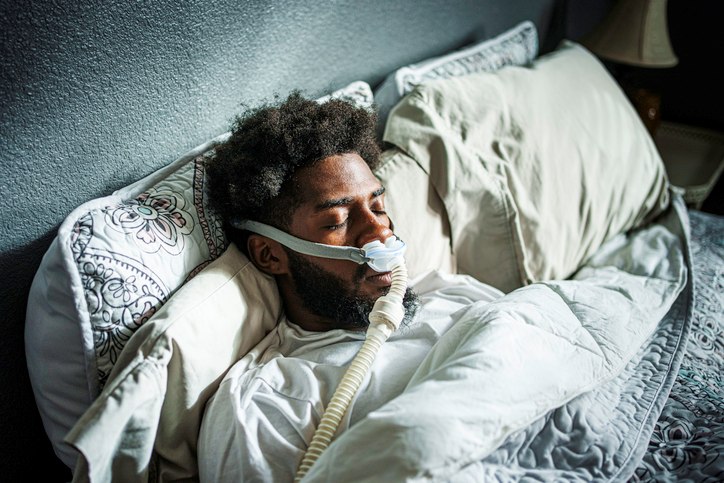
After you complete a sleep test at home, you’ll return the testing device so the data can be analyzed for the type and severity of your condition. We’ll review the results and discuss a path forward. Based on the diagnosis, treatment options include a custom-fitted oral appliance to keep your airway open comfortably. More severe cases might require Continuous Positive Airway Pressure (CPAP), which uses a mask over the nose or nose and mouth to provide a continuous flow of air to keep your airway open, even as you fall asleep.
Why Choose Our Practice for Sleep Apnea Testing?
Our dental practice combines advanced dental sleep medicine with a compassionate, patient-first approach. Your condition is unique to you, so we offer personalized care plans rather than one-size-fits-all solutions. At-home testing makes getting a sleep test easier than ever. With years of experience and a commitment to using the latest technology, we’re dedicated to helping you achieve better health.
FAQs
In-lab studies require an overnight stay at a sleep center where technicians monitor you with various sensors. A home test uses a portable device you take home, allowing you to sleep in your own bed. In-lab studies collect more data points, but home tests are more convenient, less expensive, and sufficient for diagnosing obstructive sleep apnea in most patients.
On the day of the test, try to follow your normal routine as much as possible. Avoid napping and limit caffeine or alcohol intake, as both can disrupt your sleep. You’ll be provided with specific instructions on how to set up the device before you go to bed.
During the test, you’ll wear a small device with sensors attached to your finger, nose, and chest. The device is quiet and designed to be as unobtrusive as possible. You simply turn it on when you go to sleep and turn it off when you wake up; the machine does the rest.
Modern at-home sleep tests are highly accurate for diagnosing obstructive sleep apnea in adults. The sensors measure key indicators like airflow, oxygen saturation, and breathing effort. If your results are inconclusive or if you’re suspected of having other sleep disorders, like narcolepsy or restless leg syndrome, you might be recommended for a follow-up in-lab study for a more detailed analysis.
The device records your body’s biological signals while you sleep. A nasal cannula measures airflow, a belt around your chest measures breathing effort, and a finger probe measures oxygen levels and heart rate. This data is stored on the device and downloaded when it’s returned.
If you’re tired during the day or are told you snore loudly or have breathing pauses, ask about a home sleep study at Jeffrey A. Stratford-Jones, DDS. Insufficient sleep disrupts your daily routine and can lead to long-term health issues. Contact our office to learn more about testing.